
McGlothlin Courtroom

The world’s most technologically advanced trial and appellate courtroom, where the past combines with the present to produce the future

What the McGlothlin Courtroom offers:
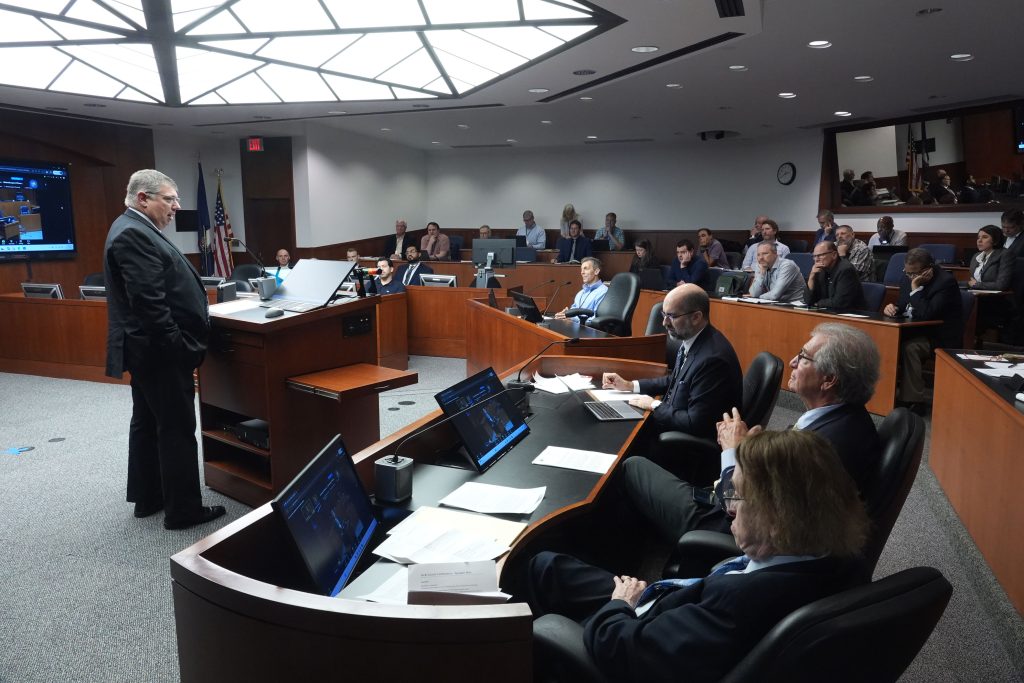
The McGlothlin Courtroom’s technologies include: 

– An AI-Chatbot information and location kiosk immediately outside the Courtroom

– State-of-the-art infrastructure permitting cabled and wi-fi data transmission

– Enhanced audio with state-of-the-art digital microphones, digital audio processors, and provision for hearing assistance,
electronic recording and remote communications 

– Custom mill work and adjustable seating

– Visual digital display (in the courtroom and remote) by counsel and, if need be, judge, of information and evidence for
motion practice, voir dire, opening statements, closing arguments, and presentation of evidence with the locations of
displayed information controlled by the judge or courtroom technologist

– Individual display monitors for each juror

– Compatibility with a wide variety of digital devices to include tablets, computers, and smart phones for counsel and judge; 
Origination of digital visual information by counsel by document camera or digital devices such as tablets, computers, and
smart phones

– Holographic display of evidence

– Every current form of court record capture including stenographic, voice-writing and electronic recording further including
Artificial Intelligence enabled automatic speech to text transcription and the ability to interpret via text 106 languages and
dialects. 

– An experimental Artificial Intelligence system that in bench trials advises judge and counsel of the likelihood that a witness
is not testifying truthfully

– Numerous forms of assistive technology including wheel chair/scooter ramps and lift, image enhancement; audio
explanation of visual materials for those unable to see; audio hearing assistance

– Access to digital legal and other forms of information. 

The best-known physical aspect of the Center for Legal and Court Technology is the McGlothlin courtroom. Located on the ground floor of Willaim & Mary Law School, the McGlothlin Courtroom is generally accepted to be the world’s most technologically advanced trial and appellate courtroom. Upon entrance, visitors often see visual displays:  Welcome to the McGlothlin Courtroom, where the past combines with the present to produce the future.  Given that the Law School is the oldest law school in the United States, it seems only appropriate that today’s CLCT staff and Fellows build on past achievement to produce the future we will all share. 

The McGlothlin Courtroom is a teaching classroom, especially for the CLCT- supported course, Technology-Augmented Trial Advocacy; the location for many different special presentations, and the heart of CLCT’s empirical and physical experimental work. Using both state-of-the-art software such as zoom and teams, and special purpose video conferencing hardware, the Courtroom is fully “hybrid,” allowing any combination of physically present and remote participants and includes a state-of-the-art judge’s chambers that allows remote hearings.

Our Participating Companies

This is all made possible via technology loans and supply of services, all at no cost, from CLCT’s Participating Companies, including: 

  • Arnold Reception Desk 
  • AudiaTechnica 
  • AudioScience 
  • Biamp 
  • Chief 
  • Cisco 
  • Clock Watch 
  • Crestron 
  • Crown 
  • CyberPower 
  • Dell 
  • Elmo 
  • ErgoGenesis (BodyBuilt Inc.) 
  • Extron 
  • For The Record (FTR) 
  • Freedom Scientific / Vispero 
  • FSR Inc. 
  • HP 
  • Justice AV Solutions 
  • K-Array 
  • LG 
  • LifeSize 
  • Lift-U / Hogan Mfg. 
  • Loom Analytics 
  • Poly 
  • Proto 
  • Samsung 
  • Smart Technologies 
  • Sony 
  • Speech2Data
  • Stenograph 
  • SurgeX 
  • Televic 
  • The Record Xchange 
  • Vaddio 
  • Williams AV 
  • Wolfvision 

History of the Courtroom

The Beginning

Work began on the McGlothlin Courtroom in 1992, when Stenograph Corporation offered to equip a Computer-Integrated Courtroom for the National Center for State Courts (NCSC).

As NCSC did not have a courtroom of its own, NCSC approached Law Professor Fred Lederer at the William and Mary Law School next door, who agreed to host and support the effort. Stenograph Corporation furnished the Law School’s McGlothlin Courtroom with a multi-frame remote arraignment, visual record system, and a state-of-the-art real-time transcription system.

Martin Gruen, our current Deputy Director Emeritus and then president of Sight and Sound Solutions, installed the courtroom upgrades. A year later the experiment went a step further, and the idea of an international model facility was born. David Buswell, who was a representative for Stenograph Corporation, became the driving force behind the project.

AN Emerging Legacy

Although the courtroom was an instant success, no one knew just how big of a success it would become. With no financial support or a budget of any kind, the situation became critical as the workload quickly grew.

The project owes its survival in those early days to the National Court Reporters Foundation, which provided funds for the first paid staff member, Court Reporter April C. Artegian, who became the Administrator and Court Record Manager.

As the project continued to grow, the workload increased beyond the ability of the permanent and volunteer staff, even with the assistance of many talented students.

Buoyed by a charitable and timely donation from benefactor Richard Herrmann, Carol Ely was hired as the first full-time administrator.

Our Thanks & Gratitude

Through the years, the work has continued thanks to the many generous people who have given their time, talents and finances to help us reach our goals.

The Center for Legal & Court Technology owes each of these people a deep debt of gratitude, and would like to add a special thanks to two individuals:  Martin Gruen and Richard Herrmann.

Martin has not only given equipment and financial support, but his donation of countless hours of time has made this project possible and continues to sustain it. His creative vision has expanded our project in many ways, notably in the creation of the Court Affiliates Program.

Richard Herrmann was the courtroom’s first individual financial benefactor. His donations allowed the project to survive its infancy and enable its growth to continue.